


The tower-winery
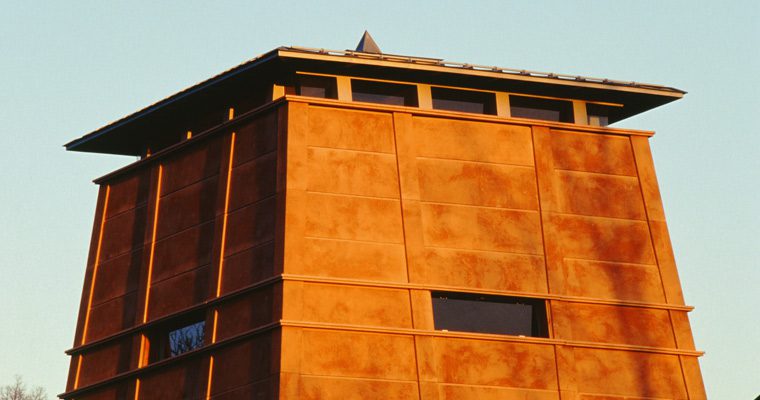
The Gramogliano tower-winery is, from its very name, the project of an architectural synthesis between conflicting concepts:
– between the tower that rises upwards and its base that sinks into the ground;
– between the internal spherical dome resting on four points and the square floors, where the material is missing precisely at the center;
– between the walls inclined like an ancient bastion and the hidden cavity behind the large terracotta slabs that cover it.
Even the materials with which it is built are used in a way radically different from their traditional application:
– the wooden floors are constructed with laminated wood beams always smaller than the span they must cover, just as in the 18th-century works of Rondelet;
– between the internal spherical dome resting on four points and the square floors, where the material is missing precisely at the center;
– The four-sloped roof covered in Rheinzink is made from a single large beam cut into four isosceles trapezoids, so that, inclined inward, they fit together like the four slopes of a pyramidal roof;
– the terracotta elements, which traditionally never exceed 50–60 cm, are here used as large slabs measuring 280 x 60 cm, made from a mixture of Impruneta clay and resin;
– the large slabs, finally, are hung on two steel pins from the inside rather than at the edges, while a third pin regulates their inclination.
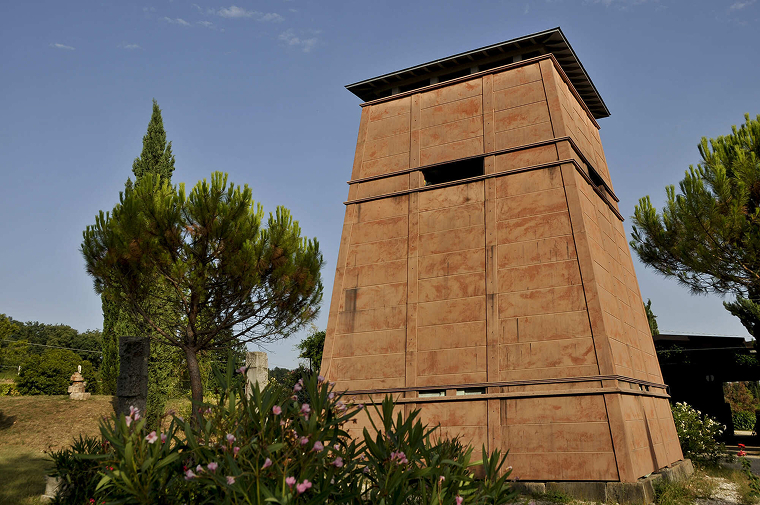
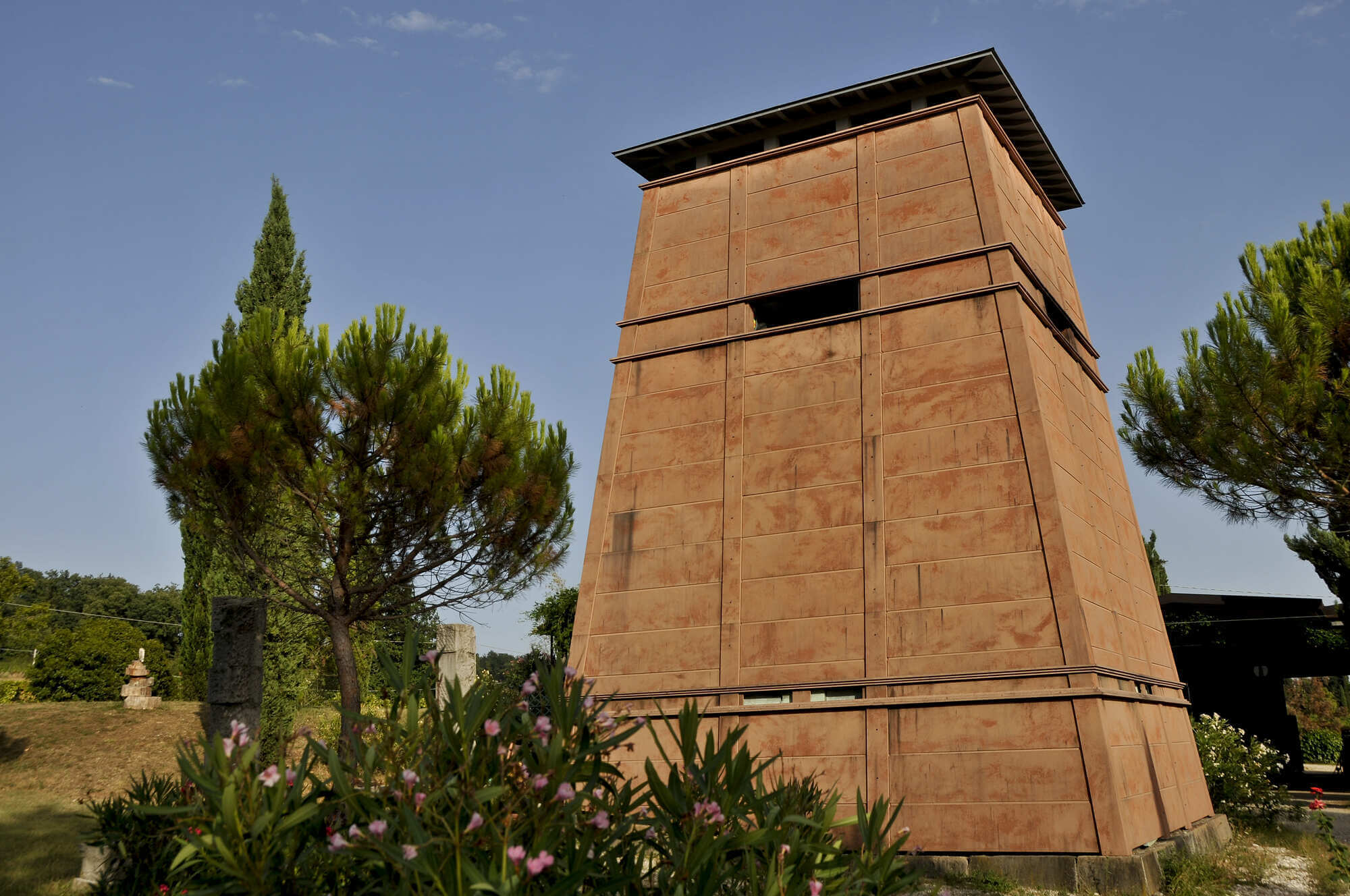
The four floors of the tower are pierced at the center by four circular openings, whose diameter decreases from bottom to top, creating a false perspective. Looking up from the decorated cellar floor toward the roof, the tower appears much taller than it actually is.
Within this conical opening, suspended from the zenith of the roof by a ball bearing that prevents the thin steel wire from twisting, hangs a large sphere attached to a 13.5-meter cable. On the floor beneath it, where the sphere swings, an engraved clock modeled after the one in Schaffhausen marks the Earth’s rotation through the slow movement of the pendulum.
One might wonder why this small tower-winery had to face and solve such a great number of problems; the answer is simple: it was the place of experimentation for a university research project on the technologies of traditional materials, used here for the first time in an extreme and never-before-tested way.
Compared to other research fields, that of architecture requires a final verification, which is the built work itself. This means that one can innovate the assembly technology of certain industrial components, but there will never be a technologically verifiable and aesthetically assessable PROOF unless the work of which the components are part is actually built.
One might wonder why this small tower-winery had to face and solve such a great number of problems; the answer is simple: it was the place of experimentation for a university research project on the technologies of traditional materials, used here for the first time in an extreme and never-before-tested way.
Compared to other research fields, that of architecture requires a final verification, which is the built work itself. This means that one can innovate the assembly technology of certain industrial components, but there will never be a technologically verifiable and aesthetically assessable PROOF unless the work of which the components are part is actually built.
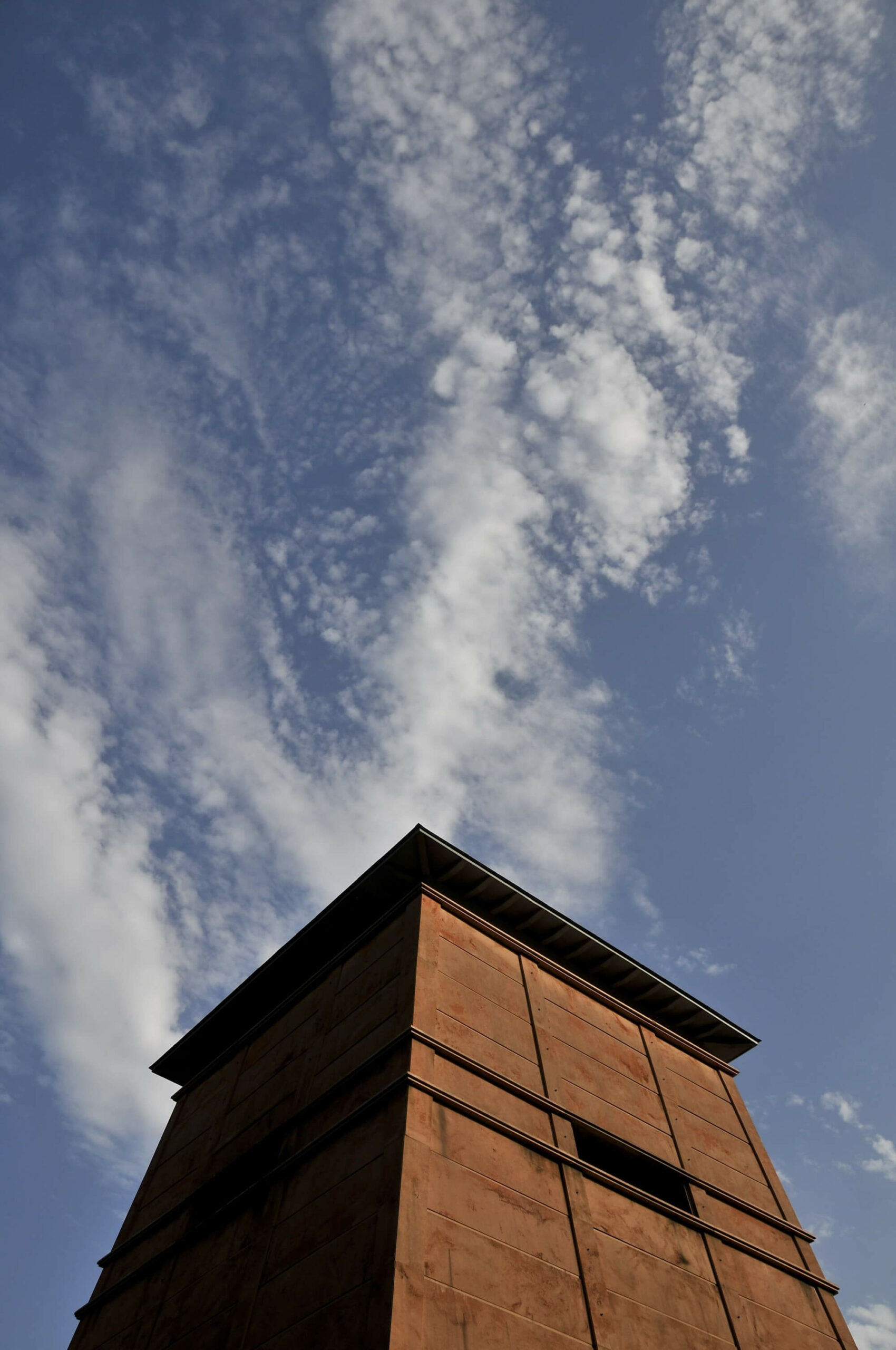
But what were the technological development interests explored through the experimental research carried out in the Perusini winery?
The development of Cottostone slab technology “beyond the vertical plane” for ventilated walls and of Cottostone moldings obtained by gluing long and narrow profiles of regenerated terracotta;
The development of laminated wood technology, applied to the gluing of curved elements to form shells or spherical domes, or elaborated to produce floor structures. The latter were designed to create stress states made possible by cutting the beams with oblique side faces, allowing them to behave like keystones of a stone arch.
A final consideration: the new European law regulating university research of national interest requires the experimentation and construction of prototypes within the relevant industries — as has long been the case in Northern European universities.
Although the application of this European law on scientific research is of recent adoption in Italy, the Gramogliano tower represents the only “built” example in our country.
Augusto Romano Burelli
April 2003
Research group:
– prof. Augusto Romano Burelli, Dipartimento di Progettazione Architettonica, IUAV
– prof. Gianfranco Roccatagliata, Dipartimento di Costruzione dell’Architettura, IUAV
– arch. Maurizio Trevisan, assistente incaricato IUAV, progetto architettonico
– prof. Franco Laner, Dipartimento di Costruzione dell’Architettura, IUAV
– ing. Francesco Stefinlongo,calcolo strutture in acciaio e strutture a guscio
– arch. Emanuele Garbin, ricercatore IUAV, specialista progettazione CAD 3D
– arch. Francesco Migliorini, progettista CAD 3D.