

Gianpietro Carlesso
The fascination with pure material and the search for a defined form that gives meaning to the material without depriving it of its natural expressiveness are the main characteristics of Gianpietro Carlesso’s work, the fixed points that make his path coherent and recognizable from the beginnings to today, in his slow, progressive, and intense evolution.
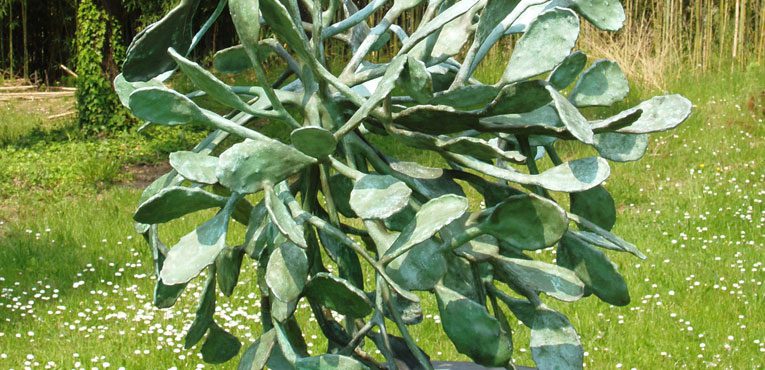
The desire to merge the rationality of form with the naturalness of the material chosen each time for the sculptural work is, in fact, a constant, in which the internal dialectic of each piece aims, on one hand, to reveal the intimate and hidden beauty of nature, and on the other, to abstract it from the contingencies of the moment, securing it within a dimension of eternity inherent to the world of art.
The works from a few years ago played on the razor’s edge of the relationship between organic and inorganic, reaching a perfect and absolutely irresolvable balance between the two components, capable of summarizing the very essence of nature. Combined with the constructions and “deconstructions” evidenced by even earlier works, they marked a progression in the research toward the identification of the rational abstract form within the accidental natural form.
The interplay of rational drive and natural beauty entails, so to speak, the aspiration for a symbiosis between the artist and the material, in which the creator seems to retrace the footsteps left by Klee.
When Paul Klee spoke of wanting to draw from the vital sap and what he called the “formative forces” of nature, he connected to the roots of the tree to create his personal design of a natural reality, but not necessarily naturalistic, one that contained within itself the strength, mystery, and fascination of nature; and his works were at once abstract and figurative, unreal and real simultaneously, rigorous and imaginative together.
The same concepts of rationality and naturalness, of abstract model and organic structure, appear interchangeable within Carlesso’s works, where he seeks to reproduce the hidden harmony inherent in plants, sometimes contrasting it with the material irregularity of rock or, conversely, with the clear geometry of marble. Or, again, where he chooses to give voice to the natural intervention on the pure form of the initial model, tracing its path and following its evolution.
But it is in the more recent works that abstraction and concretion clearly end up being two sides of the same coin.
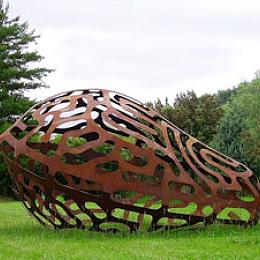
The seed, the subject that particularly captivates the artist in his current phase of research, is the union of the two aspects: natural – rational, concrete – abstract, unique and absolute.
A seed that, in its elementary, pure, simple, essential form, contains within itself the design of a form to come, deriving it from a heritage of ancestral memory: encompassing within itself a DNA with a plastic structure that is absolutely perfect and complete.
The seed as both a starting point and an endpoint for the idea of creation and for creation itself.
– Franca Marri maggio 2006